 University of North Texas


Educators often distinguish between explicit knowledge, which consists of the facts and frameworks students learn, and tacit knowledge, which is the judgment and practical understanding that develops through experience. Audhesh Paswan, professor of marketing, said explicit knowledge has become increasingly commonplace, while the ability to apply it remains a key differentiator for graduates.
“Everyone has access to thousands of cookbooks, but not everyone can cook well,” Dr. Paswan said. “For that, you need tacit knowledge. Industry visits help students connect explicit knowledge to that ‘aha’ moment.”
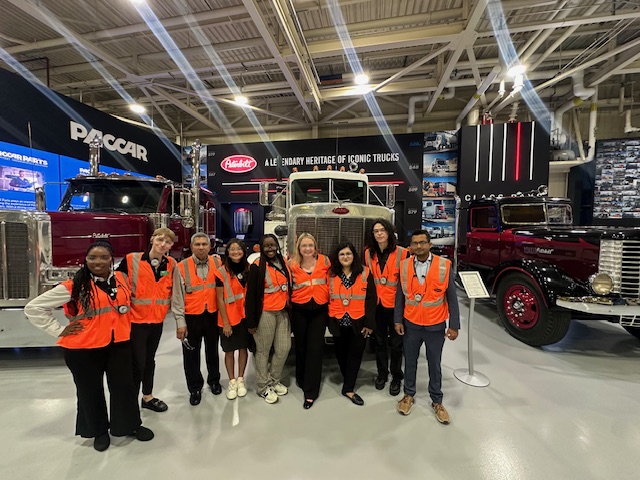
That principle guided a recent visit by the MBA cohort students, as part of the Innovation and Creativity class, to Peterbilt, where they observed the production process as a truck moved from individual components to a finished vehicle. The visit served as the foundation for a consulting challenge from Peterbilt that asked students to develop new strategies for recruiting and retaining talent.
Observing operations firsthand gave students an understanding of the people, roles, and processes involved in manufacturing. Paswan said that perspective was essential because the challenge centered on human capital, and students needed to understand what working in that environment entails before they could recommend ways to attract and retain employees.
The project also demonstrated how business disciplines intersect in practice. Although students study marketing, finance, human resources, and accounting in separate courses, organizational challenges often don’t fall within a single discipline domain. As students worked on the Peterbilt challenge, they found that an apparent workforce shortage involved market segmentation, targeting, positioning, value proposition development, budgeting, accounting, and strategy, to name a few.
“Rarely do we find a problem focusing purely on one domain, such as marketing, finance, or HR. Business problems are often multidimensional,” Paswan said. “A live project with experiential learning helps students see the connection and approach the problem in a holistic manner.”
Experiential learning also prepares students to make decisions under uncertainty, a skill that professional environments demand. Working through an actual company challenge requires students to distinguish a problem from its symptoms, evaluate viable solutions, and weigh their costs, benefits, and limitations.
“Life does not give you multiple-choice questions, and there is no one right answer,” Paswan said. “I hope that the experience of an industry visit and working on an industry challenge helps students realize that.”
Paswan said the purpose of business education is to develop human capital capable of addressing the challenges facing companies, industries, and society. In his view, industry visits support that goal by helping students translate explicit knowledge into tacit knowledge, integrate multiple fields of study, and create value by bringing different areas of expertise together.
Through partnerships with organizations such as Peterbilt, the Ryan College of Business continues to provide students opportunities to apply their learning in professional settings and prepare for careers that require both knowledge and the ability to use it.